

Canon Eos 1d X Mark 2
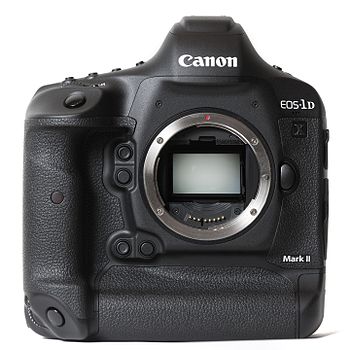 | |
| Overview | |
|---|---|
| Blazon | Digital unmarried-lens reflex camera |
| Released | April 2016 |
| Intro cost | US$ 5,999.00 |
| Lens | |
| Lens | Interchangeable (EF) |
| Sensor/medium | |
| Sensor blazon | CMOS |
| Sensor size | 36.0 × 24.0 mm (Full-frame) |
| Maximum resolution | 5472 × 3648 (xx.two effective megapixels) |
| Film speed | 100 – 51200 (expandable from Fifty: 50 to H1: 102400; H2: 204800; H3: 409600) |
| Storage media | Dual slots: CFast 2.0 and CompactFlash (CF) Type I (UDMA-7 supported) |
| Focusing | |
| Focus modes | One-Shot, AI Servo, Manual |
| Focus areas | 61 AF points (41 cross-type AF points) with Loftier-Density Reticular AF Ii |
| Exposure/metering | |
| Exposure modes | Programme AE, Shutter priority AE, Aperture priority AE, Manual exposure, Bulb exposure, Custom, Moving-picture show |
| Exposure metering | approx. 360,000 pixel RGB+IR sensor, EOS iTR AF |
| Flash | |
| Flash | External |
| Shutter | |
| Shutter | Electromechanical carbon cobweb focal-plane |
| Shutter speed range | i/8000 s – 30 southward, Bulb; 10-sync at 1/250 south |
| Continuous shooting | 14 fps with full AF/AE tracking; 16 fps in Live View mode |
| Viewfinder | |
| Viewfinder | Eye-level pentaprism with 100% coverage and 0.76x magnification / LCD (Live View) |
| Image processing | |
| Prototype processor | DIGIC 6 and dual DIGIC 6+ |
| White rest | Available |
| WB bracketing | Available |
| General | |
| Video recording | 4096 × 2160 (DCI 4K), 59.94 fps, approx. 800 Mbps |
| LCD screen | 3.2" (viii.1 cm) Clear View 2 colour TFT LCD touchscreen with one,620,000 dots |
| Bombardment | LP-E19 |
| Trunk features | Grit and weather sealed magnesium blend |
| Dimensions | 167.half-dozen mm × 158 mm × 82.6 mm (6.threescore in × 6.22 in × 3.25 in) |
| Weight | i,340 1000 (2.95 lb) including battery, torso only |
| Fabricated in | Japan |
| Chronology | |
| Replaced | Catechism EOS-1D Ten[1] |
| Successor | Canon EOS-1D 10 Mark 3[2] |
The Canon EOS-1D X Mark 2 was the company's 20-megapixel full-frame DSLR flagship camera, announced on Feb ane, 2016, by Canon with an MSRP of US$5,999.00. Information technology is the successor to the Canon EOS-1D X, which was released in 2012.[3] [4]
On Jan vi, 2020, Canon introduced the Catechism EOS-1D X Mark Iii as the successor to the EOS-1D X Mark II.[2]
Features [edit]
New features over the Canon EOS-1D X are:
- DCI 4K (4096×2160) with up to 60 fps (59.94 fps) upward to 29'59" (4K tin can only exist recorded internally in MJPEG, the HDMI output is limited to 1080p)[v]
- Continuous shooting rate of upward to fourteen frames per 2nd with full autofocus; xvi fps in live view with locked focus and exposure. These rates are available when using the new LP-E19 battery. The EOS-1D X Mk Two accepts the LP-E4N batteries of the Mk I and LP-E4 batteries of the 1D Mark IV, but burst style reverts to the Mk I maximum of 12/14 fps.
- Full Hard disk video (1920×1080) up to 120 fps (119.9 fps)
- All AF points support to a maximum aperture of f/8[half dozen]
- Digital lens optimizer for JPEG shooting.
- AI Servo AF III
- Continuous red illumination of all AF points
- Support for CFast (a variant of CompactFlash) memory cards
- Built-in GPS used for geotag data and syncing to UTC time[7]
- One additional cease of ISO range with it being expandable to 409600
- Anti-flicker feature (introduced with the EOS 7D Mark II) – camera can be set up to conform the moment of exposure to compensate for flickering electric lighting
- A touchscreen LCD, which allows videographers to select the camera'south AF signal before and during video recording.
- Wi-Fi for wireless file transfer (with wireless transmitter)[7]
Comparing with the EOS-1D X [edit]
| Model | EOS-1D X | EOS-1D X Marking Ii |
|---|---|---|
| Sensor size | Full-frame (36x24mm) | |
| Sensor resolution | approximately eighteen.1 megapixels (5184×3456) | approximately xx.2 megapixels (5472×3648) |
| Metering sensor | approximately 100,000 pixel RGB sensor (with dedicated DIGIC four processor) | approximately 360,000 pixel RGB+IR metering sensor (with dedicated DIGIC half-dozen processor) |
| Autofocus points | 61 points (41 cantankerous-type), 1-5 signal (cross-type) at f/2.viii 10-20 point (cross-type) at f/four.0 xv-21 point (cantankerous-type) at f/v.6 i point (cross-type) at f/8.0 | 61 points (41 cross-type), 61 points (21 cross-type) at f/8 |
| Processor | Dual DIGIC five+ | Dual DIGIC 6+ |
| ISO sensitivity | 100 – 51200 (Lo: 50, upward to H2: 204800) | 100 – 51200 (Lo: 50, upward to H3: 409600) |
| Max. continuous shooting | approximately fourteen fps with mirror locked up (JPEG), approximately 12 fps with full AF/AE tracking (JPEG/RAW/RAW+JPEG) | approximately 16 fps in alive view mode (JPEG/RAW/RAW+JPEG), approximately xiv fps with total AF/AE tracking (JPEG/RAW/RAW+JPEG) |
| Shutter speeds | 1/8000 southward to xxx s, seedling, x-sync at 1/250 s | |
| Video tape | Full Hard disk drive (1920×1080): 60 fps/50 fps/xxx fps/25 fps/24 fps (MPEG-4 AVC/H.264), ALL-I and IPB supported | DCI 4K (4096×2160): 60 fps/50 fps/30 fps/25 fps/24 fps (Movement JPEG), Full Hd (1920×1080): 120 fps/100 fps/sixty fps/fifty fps/xxx fps/25 fps/24 fps (MPEG-4 AVC/H.264), ALL-I, IPB (standard) and IPB (calorie-free) supported |
| Viewfinder magnification | approximately 0.76× | |
| LCD | approximately 1040K pixels, 3.2" monitor | approximately 1620K pixels, 3.2" touchscreen monitor |
| Lens mount | EF mount | |
| Card formats compatibility | 2 CompactFlash (Type I&II, UDMA 7 supported) slots | 1 CFast (CFast2.0 supported) and 1 CompactFlash (Type I, UDMA 7 supported) slots |
| Battery compatibility | Canon LP-E19, Canon LP-E4N, Canon LP-E4 | |
| LAN (wired) | IEEE802.3u (supported Ethernet 1000BASE-T / 100BASE-TX / 10BASE-T) | |
| Wi-Fi | External accessory; supported IEEE802.11n (150 Mbit/due south)/ IEEE802.11a (54 Mbit/s)/ IEEE802.11g (54 Mbit/south)/ IEEE802.11b (11 Mbit/s) via Canon WFT-E6 | External accompaniment; supported IEEE802.11ac (433 Mbit/s)/ IEEE802.11n (150 Mbit/s)/ IEEE802.11a (54 Mbit/south)/ IEEE802.11g (54 Mbit/south)/ IEEE802.11b (11 Mbit/s) via Canon WFT-E8 |
| GPS | External accompaniment | Congenital-in (supported GPS satellites, GLONASS and QZSS (Michibiki)) |
| Appear | Oct xviii, 2011 (released on June 20, 2012) | February 2, 2016 (released in April 2016) |
| Dimensions | approximately 158 by 163.6 by 82.7 millimetres (half-dozen.22 in × half-dozen.44 in × 3.26 in) | approximately 158 by 167.6 by 82.6 millimetres (6.22 in × 6.60 in × 3.25 in) |
| Mass | approximately 1,340 grams (47 oz) (torso only) | |
See also [edit]
- Canon EOS-1D C
References [edit]
- ^ "EOS-1D X Marker II". Canon Camera Museum.
- ^ a b "A Masterpiece In Engineering And Pattern: Canon Announces The EOS-1D X Mark III Camera". 2020-01-07. Retrieved 2020-02-01 .
- ^ Alvarez, Edgar (1 February 2016). "EOS-1D X Marking II: Canon's flagship DSLR goes 4K". Engadget . Retrieved 2 Feb 2016.
- ^ Seymour, Tom (2 February 2016). "Catechism launch The EOS-1D X Mark II – a flagship DSLR with 4K capability". British Journal of Photography. Retrieved ii Feb 2016.
- ^ "Specifications - EOS-1D X Mark Ii". Canon UK . Retrieved 10 May 2017.
- ^ Rudy Winston (ane February 2016). "What's New: AF at f/viii with EOS-1D X Mark Ii". Catechism.
- ^ a b "EOS-1D X Marker II". Canon USA.
External links [edit]
- Official spider web page
- Sample Images & Movies

Canon Eos 1d X Mark 2,
Source: https://en.wikipedia.org/wiki/Canon_EOS-1D_X_Mark_II
Posted by: anayaseend1982.blogspot.com
0 Response to "Canon Eos 1d X Mark 2"
Post a Comment