

Is The Secret Service Really Out Of Money
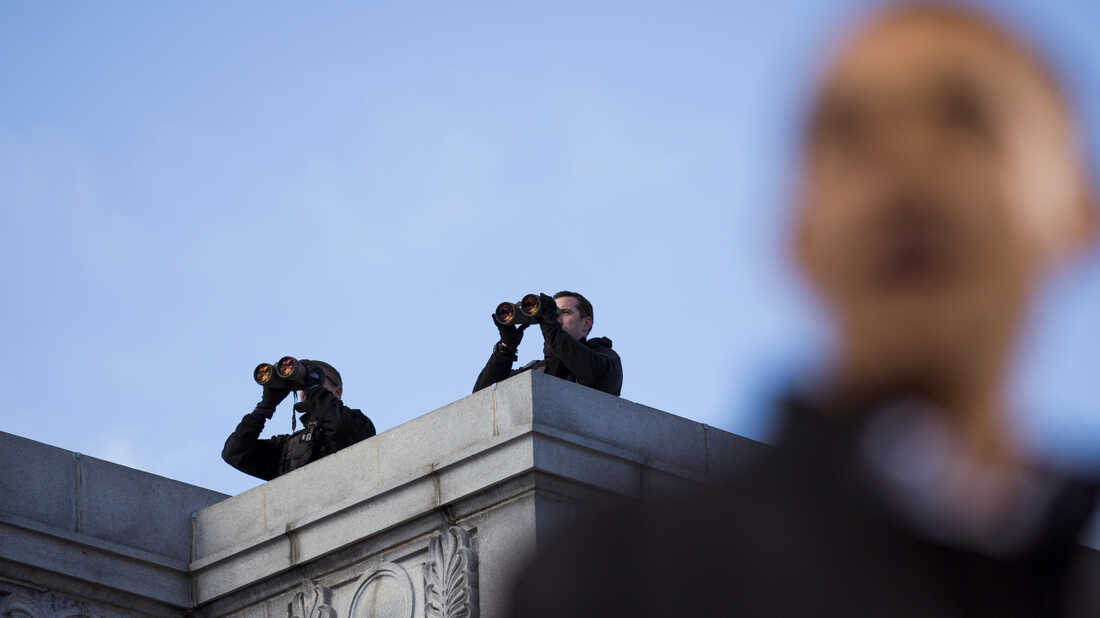
Secret Service snipers watch on a rooftop as so-President Barack Obama speaks at a 2012 campaign rally in Concord, Due north.H. Brooks Kraft/Corbis via Getty Images hibernate caption
toggle caption
Brooks Kraft/Corbis via Getty Images

Clandestine Service snipers scout on a rooftop as and so-President Barack Obama speaks at a 2012 campaign rally in Concur, N.H.
Brooks Kraft/Corbis via Getty Images
Every time the president of the United States travels, he's accompanied by a cadre of Hole-and-corner Service agents. Sometimes seen wearing crisp suits, sunglasses and ear pieces, the agents charged with protecting the president present a striking visual.
But Pulitzer Prize-winning Washington Post investigative reporter Carol Leonnig says the Undercover Service itself is something of a mess.
In her new volume, Aught Fail: The Rise and Fall of the Hole-and-corner Service, Leonnig charts the bureau's "chronic, ridiculously large mission," which includes protecting U.Due south. political leaders and their family members besides as visiting heads of state. The Secret Service is also charged with investigating financial crimes, such as counterfeit money.
Leonnig says the mission is made all the more challenging by the fact that the Secret Service is understaffed, underfunded and frequently working with outdated technology and inadequate training.
"Things were so bad in very recent years that agents were showing up to pick up a Cabinet member in their own personal car because the Secret Service's fleet was also expensive to maintain," Leonnig says.
There have also been embarrassing lapses. In March 2017, an intruder scaled the fence surrounding the White Firm and wandered the grounds, undetected, for 17 minutes. Leonnig says the breach highlighted a systemwide failure.
"The sensors, the cameras, the alarms [and] the radios didn't piece of work," she says. "This is supposed to be the virtually secure eighteen acres in the earth, and they but didn't take the money to fix those things."
Clandestine Service agents are prohibited from speaking to the press without permission, just Leonnig says a number of her sources broke the rule because they were concerned about lapses within the bureau.
"They strongly believed that it was a thing of time before a president was shot on their watch," she says. "They're worried that the agency increasingly is relying on luck. And information technology's really a matter of fourth dimension before somebody finds the right chink and gets through."
Interview Highlights
On the Hole-and-corner Service existence short staffed and burned out
On the White House complex, which is protected past Hole-and-corner Service officers, people told me that they never got a day off for months at a fourth dimension. The average was for people to take to work at least ane of their 2 days off every calendar week. You lot tin imagine the burnout that that causes; you can also imagine it affecting your pilus-trigger sort of reflexes if at that place's an actual set on. It also impacts your training. You can't step away from the job to go practise your marksmanship training and your attack on the principal grooming that's supposed to requite you those split-second reactions if you're basically called into piece of work every unmarried day. So it's a huge bear on.
On how old President Donald Trump's golf trips cost the Secret Service
Every president that travels is taking a small city with him wherever he goes. And, you know, I wrote about President Obama taking a trip to Africa, which featured a piffling chip of holiday and a lilliputian bit of piece of work. And the estimates for the toll of that trip ... were in the tens of millions of dollars. Then every president is going to cost a lot of money wherever they go. Merely what was so unusual about Donald Trump was he was deciding, offset, to travel basically every other weekend in the get-go function of his presidency, wherever he chose to golf. And the second part of that was he was traveling frequently to his own golf clubs. In fact, I don't know of a fourth dimension that he traveled to someone else's society. So that travel was, over again, simply bleeding the Secret Service dry. ... They fabricated an emergency asking in the bound for [more coin] in 2017, merely out of fear that they were non going to exist able to embrace the rest of their missions, including protecting the president and his family and protecting the White House. That's how much more money they needed for his golf game trips.
On the 2012 scandal when the advance team of Secret Service agents for Obama had sex workers in their room in Cartagena, Colombia
Agents were flown back, unceremoniously sent packing, considering they were under investigation for bringing prostitutes back to their room and turning a presidential trip essentially into similar a available's weekend in Vegas. And it really troubled, apparently, President Obama, but it also actually upset Congress. And in that location were these demands for heads to scroll. Unfortunately, the Secret Service leadership decided to, instead of look at what this shocking result revealed and endeavor to fix it — they insisted information technology was a 1-off. It was an aberration. Nothing similar this ever happened before. And senators weren't buying this when Manager Mark Sullivan testified that this was a shocking one-fourth dimension event. They felt that he was putting his caput in the sand. And in fact, what agents told me in the wake of this serial of investigations, what they told me was this happened all the time. International trips were a perk for guys who had to work ceaseless hours in a stairwell or walk convention halls for 48 hours. International trips were something people were excited most doing to just sort of blow off some steam and go out of boondocks. There was also a minor cadre of Secret Service agents who treated travel on the road with a wheels up, rings off mentality.
On then-presidential candidate Bill Clinton allegedly wanting alone time at a YMCA without his security particular
The agents who have been trained in the security protocols for months to go this plum assignment of protecting a presidential candidate who ends upwards being president, they are sort of surprised and ask more questions. What gives, boss? Why aren't we going in? We're supposed to shield the guy, or nosotros're supposed to screen the people that run across him and the supervisors explain, "Look, drop it. He's hither to meet a woman." They were pretty upset about this, not because information technology was their business concern to decide for Bill Clinton, the governor and would-be president, who he should be seeing and how he should be spending his time. They were upset because what happened on the other side of that door was their business. It was their job. They'd been trained in all these protocols about how you're supposed to secure someone and someone was telling them to permit it slide. I know a lot of people will say this is really salacious, and why do y'all take to go into this? But what I desire you to feel is what it's like to be that agent, when you're expected to exist responsible for someone's life, but you lot're not being immune to use the rules and the tools to do it. ...
A spokesman for former President Clinton has said that this is not true and information technology is an implausible scenario, and we report that in the book.
On the main criticisms of the Undercover Service after John F. Kennedy's assassination
There were three major criticisms: The beginning was — and this is not their error — they were stretched far also sparse. What I didn't realize until I really started to expect in the archives and the records and the memos [filed] past the director was that the managing director of the Secret Service, for a yr and a half before the Kennedy bump-off, had been begging for added agents and added staff, more tools to do the task considering honestly, John F. Kennedy was running them ragged. He was an energetic, lively, bonny politician who loved to be with people. And he — a little chip like Donald Trump in one respect — was traveling the country like crazy, mostly to shake easily with voters. But the agents were exhausted, and they were literally standing up comatose a lot of the time. So i of the arguments, one of the complaints was your agency was undermanned. It didn't take enough people to do everything that was necessary to really secure that road in Dallas or any of them before.
The second very personal criticism was that a series of agents — no fewer than five who worked the detail that forenoon in Dallas — had been out until 2, three and 5 a.m. the night before at a private society, drinking, sometimes meeting women. ... As was said in the very, very painful Warren Commission hearings, what human being can really have hair-trigger reflexes at 12 apex if he's been up till two or 5 in the morning drinking. And that was an unbelievable hair shirt that the service wore for a long time.
The third major criticism was sort of the basic issue of a failure of imagination, to use the term from 9/eleven. The service was warned in internal confidential memos that there were plots, chatter, if y'all will, near shooting Kennedy from a high-story building. And it wasn't that difficult for the assassin, Lee Harvey Oswald, to find an empty building and shoot at Kennedy very, very close to the road and hitting him in the neck and, ultimately, in the caput.
On how Kennedy'southward assassination haunted the Secret Service
What I likewise think Americans don't really appreciate is while Kennedy's assassination was so, so tragic for the state, it was a gut punch similar no other for the Secret Service. That haunted them. It led to suicides. It led to alcoholism. It was 1 of the worst episodes for the service, for all the obvious reasons, much harder on the service than the country. And they were absolutely adamant to never permit it happen again. And what's interesting about that for me is that they were vindicated. I hateful, the other shootings that have happened, near importantly, the endeavour on Ronald Reagan'south life. They used their training and their tools, and they fabricated split up-second decisions that were the difference between us losing that president and him continuing to alive. Information technology was life or death — and they won.
Sam Briger and Seth Kelley produced and edited this interview for broadcast. Bridget Bentz and Molly Seavy-Nesper adapted it for the spider web.

Is The Secret Service Really Out Of Money,
Source: https://www.npr.org/2021/05/17/997377737/underfunded-and-overworked-secret-service-fears-theyre-relying-on-luck
Posted by: anayaseend1982.blogspot.com
0 Response to "Is The Secret Service Really Out Of Money"
Post a Comment